What Bitcoin Is — Straight to the Point
Bitcoin is a peer-to-peer electronic cash system designed to operate without trust.
Its core purpose is simple:
- fixed supply
- decentralized validation
- permissionless value transfer
Bitcoin exists to solve one problem: money that cannot be inflated, censored, or controlled.
The Core Problem — Infinite Money vs Finite Resources
Traditional money is created by central banks. It has:
- infinite supply
- political control
- hidden inflation
Bitcoin introduced the opposite:
- a hard cap of 21 million
- predictable issuance
- no authority capable of printing more
This transforms money from debt into property.
Byzantine Generals Problem — Solved
Before Bitcoin, decentralized money failed because of the Byzantine Generals Problem: How do independent actors agree without trusting each other?
Bitcoin solved this with:
- Proof of Work
- economic incentives
- cryptographic verification
Consensus is not based on trust. It is based on math, energy, and game theory.
Satoshi Nakamoto — The Disappearance That Mattered
Bitcoin was introduced in 2008 by Satoshi Nakamoto, a pseudonymous creator whose true identity remains unknown.
There was:
- no premine
- no founder allocation
- no central leadership
This anonymity is not a weakness. It is a feature.
It ensures:
- no authority figure
- no single point of failure
- no one to pressure, arrest, or influence
Bitcoin belongs to no one. And therefore, to everyone.
Original website:
https://bitcoin.org
Bitcoin Whitepaper
“Bitcoin: A Peer-to-Peer Electronic Cash System”
Published: October 31, 2008
Whitepaper:
https://bitcoin.org/bitcoin.pdf
The Bitcoin Community — Culture, Conviction, and Maximalism
Bitcoin is more than software. It is a culture.
The Bitcoin community is known for:
- extreme conviction
- long-term thinking
- resistance to narratives and hype
Bitcoin Maximalists believe:
- Bitcoin is the only truly decentralized money
- everything else is either experimental or compromised
- security and decentralization matter more than speed or features
To outsiders, it looks like a cult. To insiders, it is discipline.
Common beliefs:
- hold your own keys
- do not trust, verify
- ignore short-term noise
- think in decades, not cycles
Bitcoiners do not chase trends. They wait.
What Bitcoin Is — And Is Not
BITCOIN IS:
- decentralized
- scarce
- censorship-resistant
- permissionless
BITCOIN IS NOT:
- a company
- a stock
- centrally controlled
- inflationary
There is no CEO. There is no marketing team. There is no reset button.
Bitcoin Timeline — Key Events
- 2008 — Bitcoin whitepaper released by Satoshi Nakamoto
- 2009 — Genesis Block mined and network launched
- 2010 — First real-world purchase (10,000 BTC for pizza)
- 2012 — First halving (50 → 25 BTC)
- 2013 — Bitcoin gains global media attention
- 2016 — Second halving (25 → 12.5 BTC)
- 2017 — Bitcoin enters mainstream awareness and futures markets
- 2020 — Third halving (12.5 → 6.25 BTC). Institutional accumulation begins
- 2021 — Bitcoin gains stock market exposure. ETFs and corporate treasury adoption. Bitcoin becomes legal tender in El Salvador
- 2024 — Fourth halving (6.25 → 3.125 BTC)
- 2025 — Bitcoin fully integrated into global financial markets. Traded alongside stocks, ETFs, and sovereign instruments
- 2026 — Record inflows into US spot Bitcoin ETFs: $697M net on January 2 alone, over $1.2B in the first two trading days (BlackRock, Fidelity leading)
- 2026 — US states move on Bitcoin reserves: Arizona, New Hampshire and Texas legislate while the federal reserve stays in preparation — real but uneven adoption
- 2026 — Morgan Stanley prepares its own Bitcoin ETF, following BlackRock's IBIT success
- 2026 — Strategy grows its treasury to 846,000 BTC (~$63.8B), the largest known corporate holder
- Oct 2026 — Thailand's SEC issues final rules for locally listed spot Bitcoin ETFs on the Stock Exchange of Thailand, effective October 16 — Bitcoin and ether are the only eligible assets at first, with custody by Thai-regulated firms
- Oct 2026 — Sberbank, Russia's largest bank, is added to the Bank of Russia's crypto exchange register (it joined the digital depository register earlier in October) under the country's new crypto law, in force since September 1 — the bank is already testing Bitcoin trades in its app and plans to open trading to all clients on December 1, while domestic crypto payments stay banned
- Oct 2026 — Charles Schwab completes the full retail rollout of Schwab Crypto: eligible clients can now buy and sell spot Bitcoin directly inside their regular Schwab accounts — direct ownership at one of the largest US brokerages (about 40 million retail clients, roughly $13 trillion in client assets), with Paxos handling execution and custody at a flat 0.75% fee per trade
- Oct 2026 — Switzerland's FINMA approves the country's first retail spot Bitcoin ETF (October 20): BIT Asset Management's Bitcoin Fund ETF (BBIT) is a fund under Swiss fund law that holds Bitcoin directly, and FINMA granted it an exemption from the usual diversification rules, citing Bitcoin's long trading history and high trading volume — trading on SIX Swiss Exchange is expected to begin in November
Sources: Bitcoin whitepaper
Final Wake-Up Call
From one cent to one hundred thousand dollars
From an experiment to the stock market
Wake up.
Bitcoin is going to infinite.
Frequently Asked Questions — Bitcoin (BTC) Explained
What is Bitcoin, in simple terms?
Bitcoin is digital money that works without a bank or a government. Transactions are recorded on a public ledger called the blockchain and verified by a global network of computers through proof-of-work mining. Anyone can send or receive bitcoin, anywhere in the world, at any time.
Who created Bitcoin?
Bitcoin was created by Satoshi Nakamoto — the pseudonym of a person or group whose identity remains unknown. The whitepaper, “Bitcoin: A Peer-to-Peer Electronic Cash System”, was published on October 31, 2008, and the network went live on January 3, 2009.
How many bitcoins will ever exist?
Only 21 million. The cap is written into Bitcoin's code and enforced by the network itself. More than 19.8 million have already been mined, and the creation rate is cut in half roughly every four years — an event called the halving — so the very last bitcoin is expected around the year 2140.
How can you buy Bitcoin in Canada?
Canadians usually buy bitcoin on a Canadian-regulated platform — such as Newton, NDAX or Wealthsimple — or on a major global exchange. You verify your identity, fund your account in Canadian dollars (Interac e-Transfer is common) and buy. For larger amounts, many holders move their coins to a personal wallet: not your keys, not your coins. This page exists to educate, not to give financial advice.
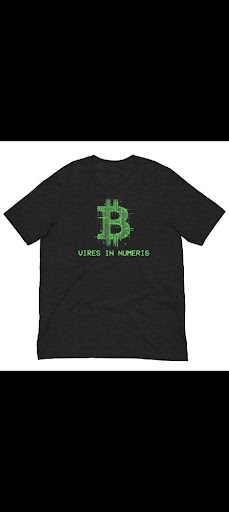
Looking for a Bitcoin t-shirt, hoodie or a gift for a crypto fan?
You're in the right place. This page features the CryptoT Bitcoin t-shirt, and there is also a Bitcoin hoodie, a budget Bitcoin tee and a budget Bitcoin hoodie. A classic gift for the bitcoiner in your life — free international shipping, sizes S to 2XL.